
Will Quantum Computers Break Bitcoin?
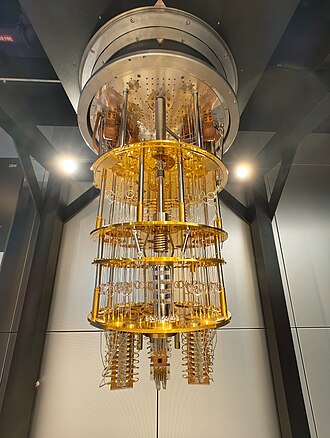
Every existential threat on this list so far has already happened. This one hasn't, which is exactly why it generates so much noise. The claim is simple enough to be frightening: bitcoin's security rests on cryptography that a sufficiently powerful quantum computer could break. The useful question isn't whether that's true — in principle, it is — but which part breaks, when, and what can be done about it.
Two kinds of cryptography, two very different risks
Bitcoin leans on two distinct cryptographic primitives, and they are not equally exposed.
Hashing (SHA-256) secures mining and the chain's structure. The best known quantum attack here is Grover's algorithm, which offers roughly a square-root speedup. In practice that's a manageable weakening, not a break — it's the sort of thing you answer by eventually doubling a parameter, and it does not threaten the chain's integrity.
Digital signatures (ECDSA on the secp256k1 curve) are the real exposure. This is what proves you own your coins. Shor's algorithm, run on a large, error-corrected quantum computer, could derive a private key from its corresponding public key. That would mean being able to spend someone else's bitcoin — the one failure mode that would genuinely end the system's usefulness.
The crucial detail: a public key is not an address
This is the part most scary headlines omit. For most of bitcoin's history, you don't hand out your public key — you hand out an address, which is a hash of the public key. A hash is not reversible by Shor's algorithm. The public key only becomes visible on the network at the moment you spend from that address, when it's revealed in the transaction.
So the exposure is narrower than "all bitcoin is at risk." Coins sitting in an address that has never been spent from are shielded behind a hash. Coins become vulnerable in two situations: during the window between broadcasting a transaction and it being confirmed, and in address types that publish the public key directly — notably the very old pay-to-public-key outputs from 2009–2010, which includes much of the stash widely believed to belong to Satoshi Nakamoto. Re-using an address after spending from it also leaves the public key permanently on the chain.
What "sufficiently powerful" actually means
The gap between today's quantum hardware and a machine that could run Shor's algorithm against secp256k1 is enormous — not a matter of a slightly better chip. Breaking a 256-bit elliptic curve key is generally estimated to require millions of stable, error-corrected logical qubits sustained through a very long computation, while real devices today operate with comparatively tiny numbers of noisy physical qubits. Progress is real and worth watching; the remaining distance is measured in orders of magnitude, not percentages.
Treat any specific date you see — from either the alarmists or the dismissers — with suspicion. Nobody credible knows the timeline.
The fix is known, and it is a soft fork
Bitcoin is not stuck with ECDSA. Post-quantum signature schemes already exist and are being standardized by cryptographers worldwide. Bitcoin could adopt one through the same upgrade mechanism that delivered SegWit and Taproot: define a new output type using a quantum-resistant signature, and let people move their coins to it. Users who move their funds are safe; the protocol itself carries on.
The hard part isn't the cryptography, it's the coordination — the subject of the block size wars. Bitcoin changes slowly by design, and a migration of this scale would need to begin well before it was urgent. The genuinely unsolvable piece is the lost coins: bitcoin in exposed addresses whose owners are dead or whose keys are gone can never be moved to safety by anyone except, eventually, an attacker. What to do about those coins — freeze them, or let them be taken — is a political question the community has never had to answer and would find deeply divisive.
How worried should you be?
For a normal holder, in the near term: not very, and there's nothing exotic to do. The sensible precautions are the ones that are good practice anyway — don't re-use addresses, and keep your coins in modern address types rather than ancient ones.
The honest summary is that quantum computing is a real but slow-moving threat with a known remedy and a long runway. That makes it unlike the sudden shocks in bitcoin's past. The thing to watch is not a headline about a new qubit record, but whether bitcoin's developers start the migration early enough that it never becomes an emergency.